Submitted to: The Single Competent Authority (SCA), Home Office
Subject: Improving access to protection and support for victims of modern slavery and human trafficking who experience continued or renewed exploitation after exiting the NRM.
1. Introduction
The National Referral Mechanism (NRM) is the UK’s framework for identifying potential victims of modern slavery and human trafficking and ensuring that they receive appropriate protection and support.
However, exiting the NRM does not necessarily mean that a person’s exploitation has ended, that they are safe from their traffickers, or that they have recovered from the abuse they have experienced.
Many women who have experienced human trafficking, sexual exploitation, domestic servitude and other forms of modern slavery remain vulnerable after leaving the NRM. Some continue to experience abuse and coercion from their original exploiters, while others are re-trafficked or become victims of further exploitation.
It is therefore important that the NRM recognises that recovery from trafficking is not always linear and that individuals may need to access protection and specialist support more than once.
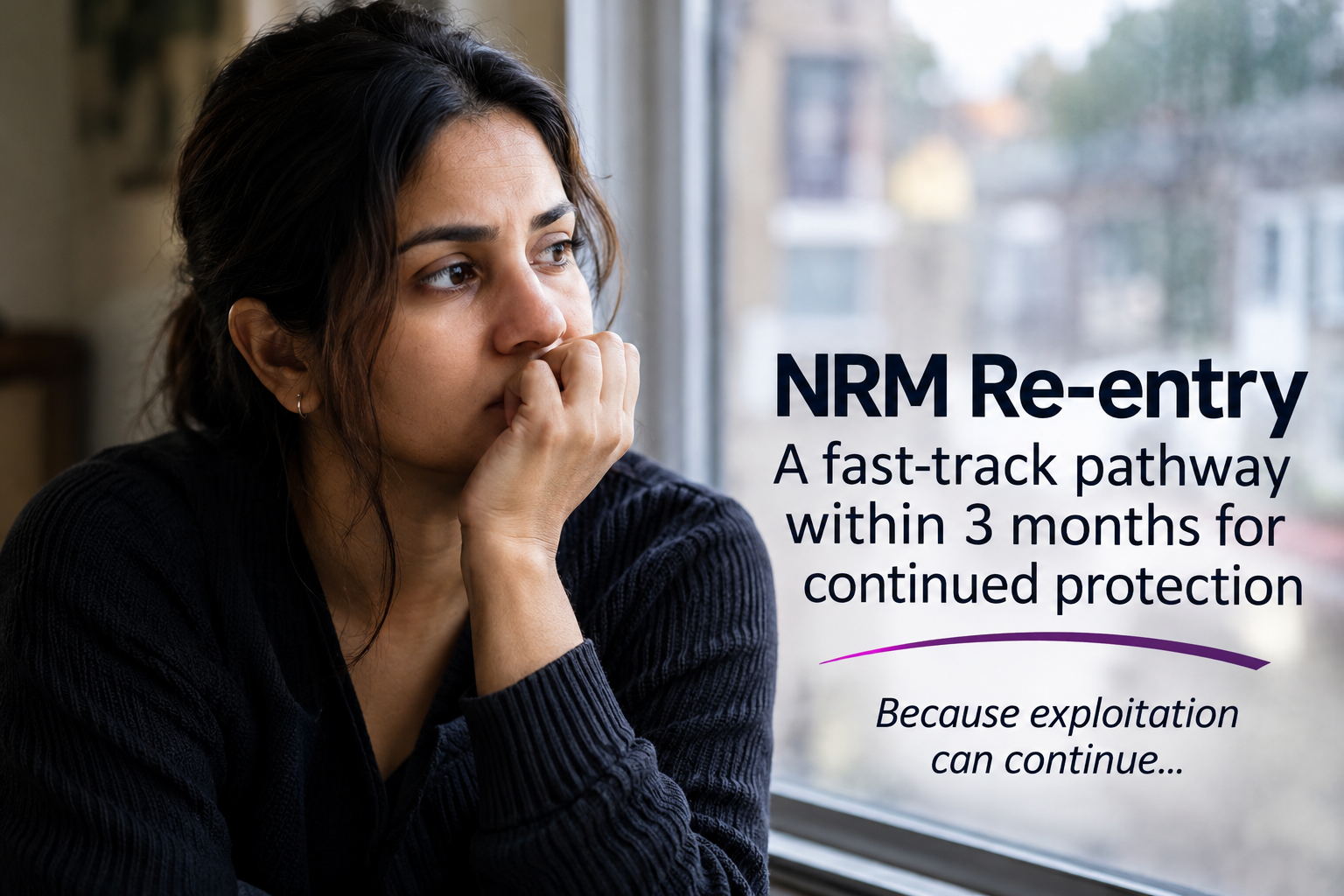
This proposal calls on the Single Competent Authority (SCA) to introduce a dedicated, streamlined re-entry process for individuals who have exited the NRM but continue to experience, or are subsequently subjected to, exploitation and abuse.
The proposed process would provide an expedited route back into NRM-related support where a person requests re-entry within three months of leaving the system, without unnecessarily requiring them to repeat the entire referral process.
2. The problem
Under the existing NRM arrangements, individuals who have previously been identified as potential or confirmed victims may need to navigate further administrative procedures when seeking to return to support.
Although current statutory guidance provides certain routes for re-entering the Modern Slavery Victim Care Contract (MSVCC), access to these arrangements depends on the individual’s circumstances, NRM status and eligibility. The existing arrangements do not necessarily provide a simple, consistent and rapid route for every person who has exited the NRM and is experiencing renewed or continuing exploitation.
Where a new NRM referral is required, the individual has to approach a First Responder Organisation and undergo another referral process. This can create additional administrative demands and delays.
For a woman who is currently being threatened, controlled, sexually exploited or trafficked, these delays can have serious consequences.
She may be left without the specialist support she needs while professionals establish her circumstances and complete the necessary administrative procedures. She may also be required to recount traumatic experiences that have already been documented through her previous NRM involvement.
The system must recognise that the need for protection can arise again after someone has exited the NRM.
3. Proposed solution: A three-month fast-track re-entry pathway
I propose that the SCA introduces a dedicated three-month fast-track re-entry pathway for individuals who have exited the NRM and subsequently disclose that they are still experiencing, or have returned to, exploitation, trafficking, coercion, threats or abuse.
Under this proposal, an individual who requests re-entry within three months of exiting the NRM should be able to access an expedited assessment using their existing NRM records and reference number.
The process should operate as follows:
3.1 Direct access to re-entry
The individual should be able to request re-entry directly through the SCA, with assistance from their solicitor, support worker, advocate or another appropriate professional.
A new First Responder referral should not automatically be required where the individual has an existing NRM record and the request relates to continued or renewed exploitation.
3.2 Use of existing NRM records
The SCA should use the individual’s existing NRM assessment, decisions, evidence and support history as the starting point for considering re-entry.
The individual should only be asked to provide additional information where this is necessary to understand their current circumstances, risks or support needs.
3.3 Expedited assessment
The SCA should introduce a fast-track assessment process to establish whether the individual remains at risk or has experienced further exploitation.
This should avoid unnecessary duplication of the original referral and assessment process.
3.4 Urgent safeguarding and support
Where an individual discloses ongoing exploitation, trafficking or abuse, safeguarding concerns should be addressed immediately.
The individual should not be left without appropriate support while administrative decisions about re-entry are being made. Where there is immediate danger, emergency safeguarding and police assistance should also be considered.
3.5 Trauma-informed practice
The process should recognise the psychological impact of trafficking and exploitation. Individuals should not be expected to repeatedly recount traumatic experiences or provide evidence already held by the Home Office unless there is a clear and necessary reason.
4. Why a three-month period is necessary
The proposed three-month period would provide a defined and accessible opportunity for individuals who have recently exited the NRM to return to protection without having to navigate an unnecessarily complicated process.
The period is intended to recognise that exploitation may continue immediately after exit or that individuals may be re-trafficked shortly afterwards.
For some victims, leaving the NRM does not mean they have escaped the influence of their traffickers. Perpetrators may continue to exercise control through threats, intimidation, debt, emotional manipulation, violence or coercion.
Women may also face significant barriers to disclosing further exploitation, including fear of their traffickers, shame, trauma, distrust of authorities and concerns about losing accommodation or other support.
A three-month fast-track arrangement would acknowledge these realities and provide a more responsive route back into protection.
Importantly, the three-month period should be a fast-track eligibility window, not an absolute cut-off. Individuals who disclose continuing exploitation or re-trafficking after three months should still be able to request re-entry through the appropriate existing arrangements.
5. The role of the Single Competent Authority
The SCA should take responsibility for developing and implementing this process through revised operational guidance.
In particular, the SCA should:
- Establish a dedicated re-entry procedure for individuals who have recently exited the NRM.
- Permit direct requests for re-entry using an existing NRM reference number.
- Avoid requiring a completely new First Responder referral where previous NRM records can be used.
- Introduce an expedited assessment process for cases involving continuing or renewed exploitation.
- Ensure that safeguarding concerns are addressed without unnecessary administrative delays.
- Provide clear guidance to First Responders, solicitors, support providers and other professionals about how to access the process.
- Monitor the number of individuals seeking re-entry and the reasons for their return to support.
The process should also be clearly distinguished from the existing re-entry arrangements for the Modern Slavery Victim Care Contract, so that individuals are not incorrectly excluded or directed through an inappropriate pathway.
6. Expected benefits
Introducing a three-month fast-track re-entry process would have several potential benefits:
Improved victim protection: Individuals experiencing continued or renewed exploitation would have a more accessible route back to specialist support.
Reduced administrative delays: Existing NRM records could be used to avoid unnecessary repetition of the referral process.
Reduced trauma: Individuals would not routinely have to repeat information about experiences they have already disclosed.
Earlier identification of re-trafficking: A streamlined process could help professionals identify patterns of repeated exploitation and respond more quickly.
Improved continuity of care: Victims would be less likely to experience gaps in support when their circumstances change after exiting the NRM.
More effective safeguarding: The process would recognise that a person’s risk of exploitation does not automatically disappear when their formal NRM support ends.
7. Recommendations
I recommend that the Home Office and the SCA:
- Introduce a formal three-month fast-track NRM re-entry pathway.
- Allow individuals to request re-entry directly, using their existing NRM reference number.
- Remove the requirement for a new First Responder referral where the individual’s existing NRM records provide an adequate basis for an expedited assessment.
- Establish clear timescales for considering re-entry requests and responding to urgent safeguarding concerns.
- Ensure that individuals who fall outside the three-month period retain access to existing re-entry arrangements where they remain eligible.
- Consult with specialist anti-trafficking organisations, survivors, legal representatives and frontline support providers when developing the new procedure.
8. Conclusion
The reality of human trafficking and modern slavery is that exploitation does not necessarily end when a person leaves the NRM.
For many women, the journey towards safety and recovery is complicated by continued threats, coercion, re-trafficking and further abuse. Some individuals may need to return to specialist support more than once before they are able to establish a safe and independent life.
The NRM must be responsive to these realities.
Requiring someone who has already been identified as a victim of trafficking to navigate an unnecessarily complicated referral process again, while they may still be experiencing exploitation, risks creating avoidable barriers to protection.
The proposed three-month fast-track re-entry pathway would provide a practical mechanism for addressing this gap. It would build on existing re-entry arrangements while recognising the need for a simpler and more immediate response for individuals who have recently exited the NRM.
The fundamental principle should be that exiting the NRM must never be treated as evidence that exploitation has ended. Where a person continues to be abused, trafficked or exploited, there must be an accessible and timely route back to protection.
The Single Competent Authority should therefore introduce a dedicated three-month fast-track re-entry procedure as part of its commitment to improving victim safeguarding, continuity of care and access to support.
Bibliography and references
The following sources provide the policy and legal context for the proposal. They also demonstrate that re-entry into support is already recognised within Home Office policy, providing a foundation for the proposed improvement.
1. Home Office (2026). Modern Slavery: Statutory Guidance for England and Wales under Section 49 of the Modern Slavery Act 2015. Published 11 May 2026. In particular, paragraphs 8.35–8.38, which address re-entry into the Modern Slavery Victim Care Contract following exit from support.
Available from GOV.UK – Modern Slavery Statutory Guidance.
2. Home Office (2026). National Referral Mechanism Guidance: Adults (England and Wales). Updated 18 September 2026. Guidance on referrals, First Responder responsibilities, competent authority decisions and access to support.
Available from GOV.UK – National Referral Mechanism Guidance.
3. Modern Slavery Act 2015. Chapter 30. Legislation establishing the statutory framework for addressing modern slavery in England and Wales, including the statutory duty to notify potential victims under section 52.
Available from legislation.gov.uk.
4. House of Commons Library (2025). The tenth anniversary of the Modern Slavery Act 2015. Parliamentary briefing examining the operation of the legislation, the NRM and victim support arrangements.
Available from the House of Commons Library.
5. EXC v Secretary of State for the Home Department [2024] EWHC 935 (Admin). High Court judgment considering aspects of modern slavery victim support, including post-NRM support and re-entry arrangements.
Available from BAILII.
An important policy distinction: The Home Office’s May 2026 statutory guidance already recognises re-entry into MSVCC support in certain circumstances, including self-referral for eligible confirmed victims. Therefore, the proposal is not that re-entry does not currently exist. It is that the SCA should introduce a more consistent, expedited three-month pathway, particularly for people experiencing continuing or renewed exploitation, and clarify when a new First Responder referral is genuinely necessary.
This distinction makes the proposal more accurate and gives the Home Office a specific policy change to consider.
Leave a Reply