
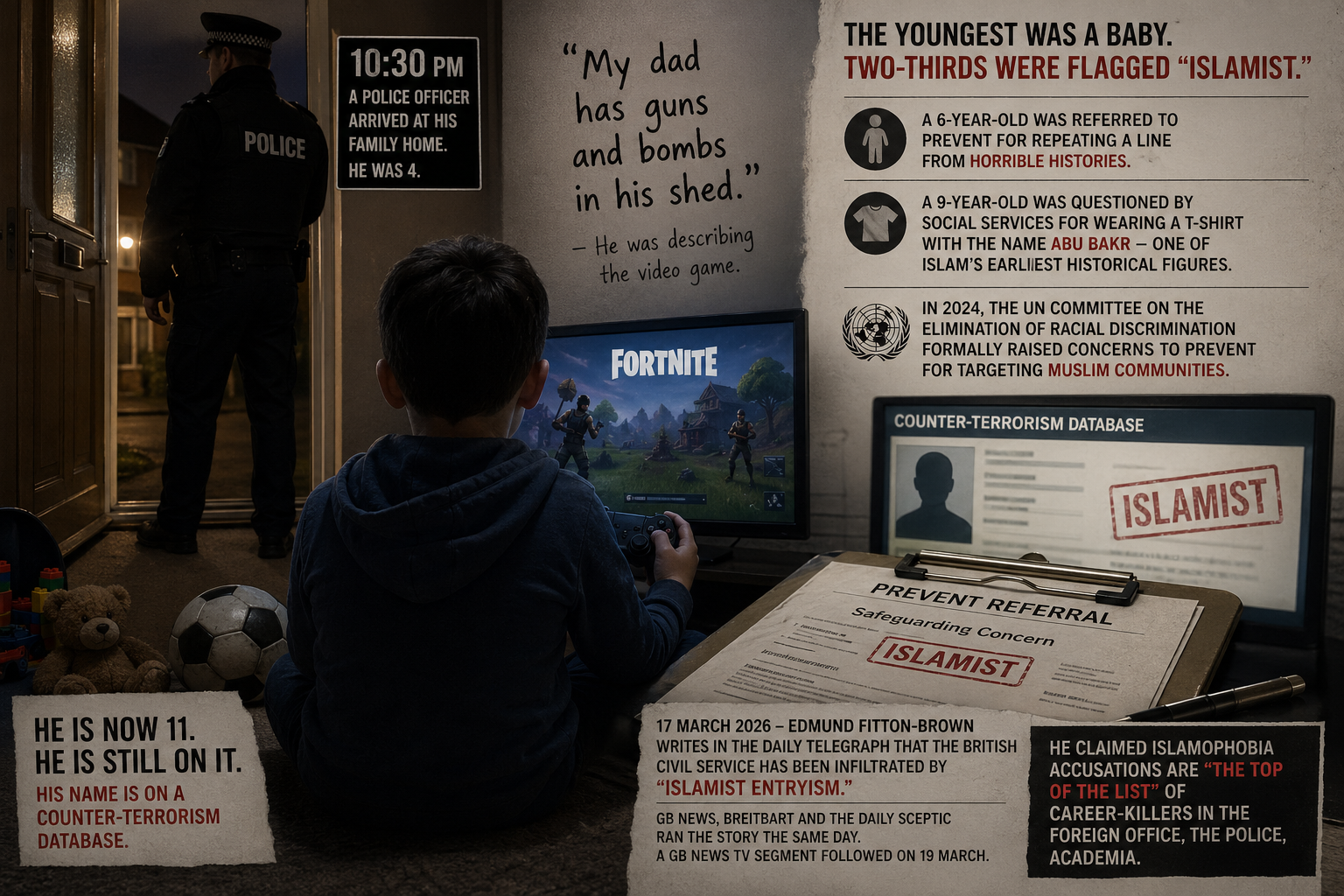
The youngest referral was a baby. Two-thirds were categorised as “Islamist”. These stark figures sit uneasily at the heart of the United Kingdom’s counter-terrorism framework, raising difficult questions about how suspicion is defined—and who it captures.
At the centre of the debate is Prevent, a strand of the government’s wider CONTEST strategy designed to stop people from being drawn into extremism. It is framed as an early-intervention safeguarding tool. Yet a series of cases involving very young children has led critics to question whether its application is, at times, disproportionate.
One such case involved a four-year-old boy in the West Midlands. Speaking casually with an after-school worker about the video game Fortnite, he said his father had “guns and bombs in his shed”. The comment, taken at face value, triggered a referral. That evening, at 10:30 pm, a police officer arrived at the family home. He was four years old.
Years later, the consequences remain. Now eleven, the boy’s name is still recorded on a counter-terrorism database. His case has become emblematic of wider concerns about how children’s language, imagination and cultural context are interpreted within security frameworks.
Other examples follow a similar pattern. A six-year-old was referred to Prevent after repeating a line from the CBBC programme Horrible Histories. A nine-year-old was questioned by social services for wearing a T-shirt bearing the name Abu Bakr—an important historical figure in early Islam. In each instance, ordinary childhood behaviour or cultural reference points were treated as potential indicators of risk.
According to Home Office data, around 6,800 referrals were made to Prevent in the year ending March 2025, with approximately 30 per cent involving individuals under the age of 18. While referrals linked to far-right concerns have risen in recent years, Islamist-related categories have historically made up a significant share. The scale of child referrals has prompted concern among educators, legal experts and community groups, who argue that the threshold for suspicion is often unclear and inconsistently applied.
In 2024, the UN Committee on the Elimination of Racial Discrimination formally raised concerns about Prevent, pointing to what it described as a disproportionate impact on Muslim communities. The committee warned that the programme risked reinforcing racial and religious profiling, particularly among young people.
The debate has also been shaped by wider political and media narratives. On 17 March 2026, Edmund Fitton-Brown wrote in The Daily Telegraph that the British civil service had been infiltrated by “Islamist entryism”. He further claimed that accusations of Islamophobia had become among the most damaging obstacles to careers in institutions such as the Foreign Office, policing and academia. His comments were quickly amplified by outlets including GB News, Breitbart and The Daily Sceptic, with a televised segment following shortly afterwards.
Supporters of Prevent argue that early intervention is essential in addressing evolving security threats and that public bodies must act on concerns, even when they are ambiguous. Critics, however, contend that the programme’s broad definitions and reliance on subjective judgement risk conflating cultural expression, religious identity or innocent remarks with genuine indicators of radicalisation.
For the families involved, the impact can be significant. Encounters with police or social services under counter-terrorism frameworks are often distressing, particularly when they arise from a child’s misunderstanding or imaginative play. The retention of personal data adds a further layer of concern, as cases such as the West Midlands boy illustrate how records can persist for years.
Prevent was designed as a safeguarding mechanism, but its application continues to expose tensions between security and fairness. The challenge for policymakers is not simply to maintain vigilance, but to ensure that efforts to protect the public do not inadvertently stigmatise the very communities they are meant to support.
Leave a Reply